Scribblings and Writings
✤ FEATURED ✤
✤ RECENT POSTS ✤
Navigating Art Markets
Hello friends! A note from Artemis here: This is an old blog post from August 2024, brought over to the new blog. Where the info is old, it's still relevant. I may revisit this topic with what I've learned in the future, but for now, enjoy a little advice from past me! I hope you're all doing well!
Good morning, everyone, and welcome back to The Night Garden!
A little while ago, I put out a video on Youtube talking about markets. Art markets, to be specific. I know a lot of people like to consume content in different ways, and so I figured I’d convert that video into a blog post here if anyone would prefer reading the post, as opposed to watching it. So, with that in mind, let’s launch right into it. If you’d prefer the video, it is embedded at the bottom of the post.
Let me paint you a picture — you are an established artist, brand new to owning a creative business, and you decide you want to vend at a market! It’s thrilling, and quite scary, because you’re not sure if you’re going to do well or if people will have an interest in what to do, but you won’t know if you don’t try, right? You’re not sure where to start, but you have a good idea of the events available in your area.
This was me a few years ago. I started my business in 2020, and I held off on doing any markets at all until 2023. Art markets are one of those things that are really daunting by nature -- they tend to take a lot of preparation, they’re really intimidating for people who haven’t done one, and there’s so much to consider about whether or not the market will be right for you. So, I figured that it’d be a good idea to talk about what I’ve learned, the pros and cons of doing markets, and what I consider when I approach them.
Disclaimer
I want to quickly throw a disclaimer here -- I’m not a business coach, nor do I claim to be an expert. I’m also not a lawyer or anything like that. I’m just a guy living in the Midwest who’s been freelancing for four years, and my opinion is one out of many. A lot of factors will change by location, interest, type of art… those types of things. This is not a one-size-fits-all for people. Hopefully you can find this helpful, and kind of boil down my experiences into a guideline for how you approach yours.
Tables
That being said, I’ll share a few pictures of my tables, and then launch into the topic.
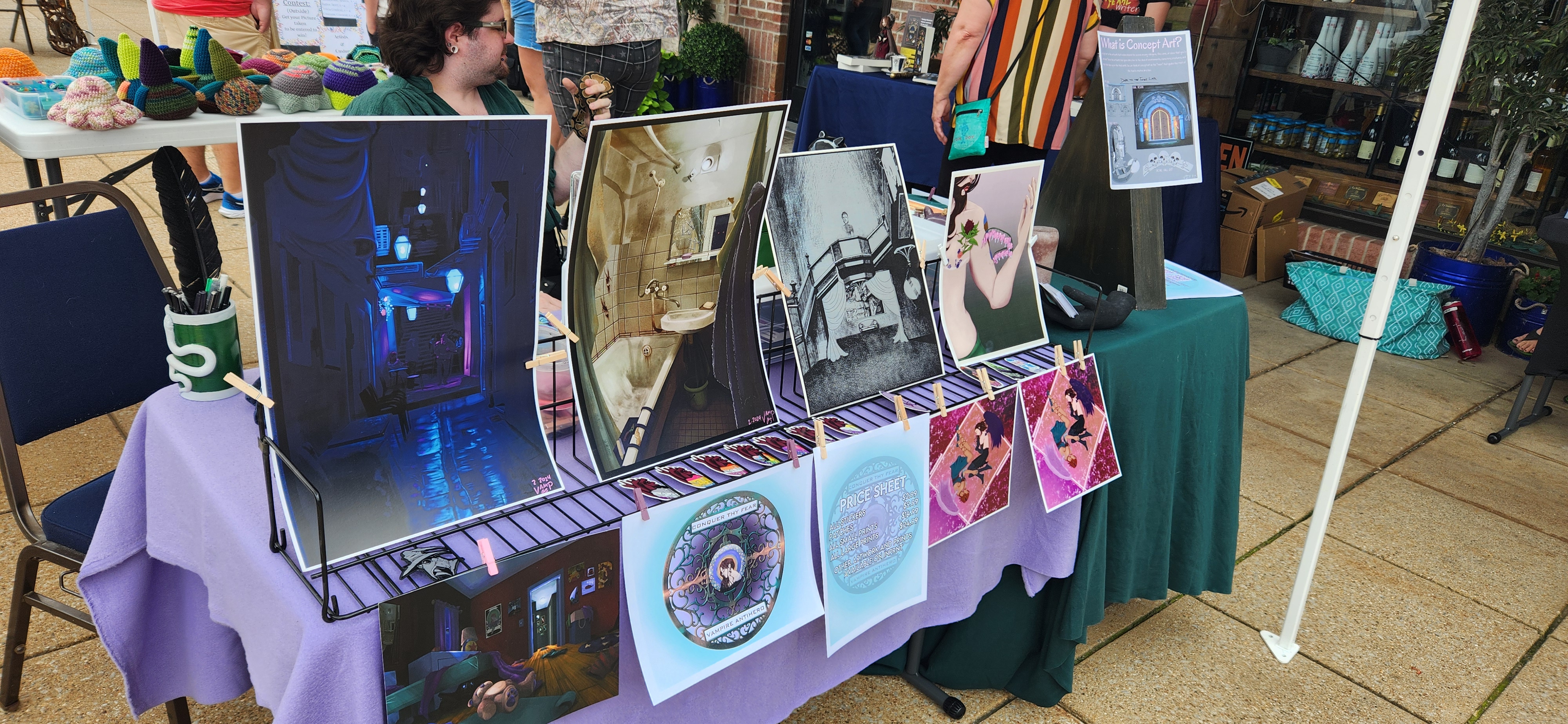
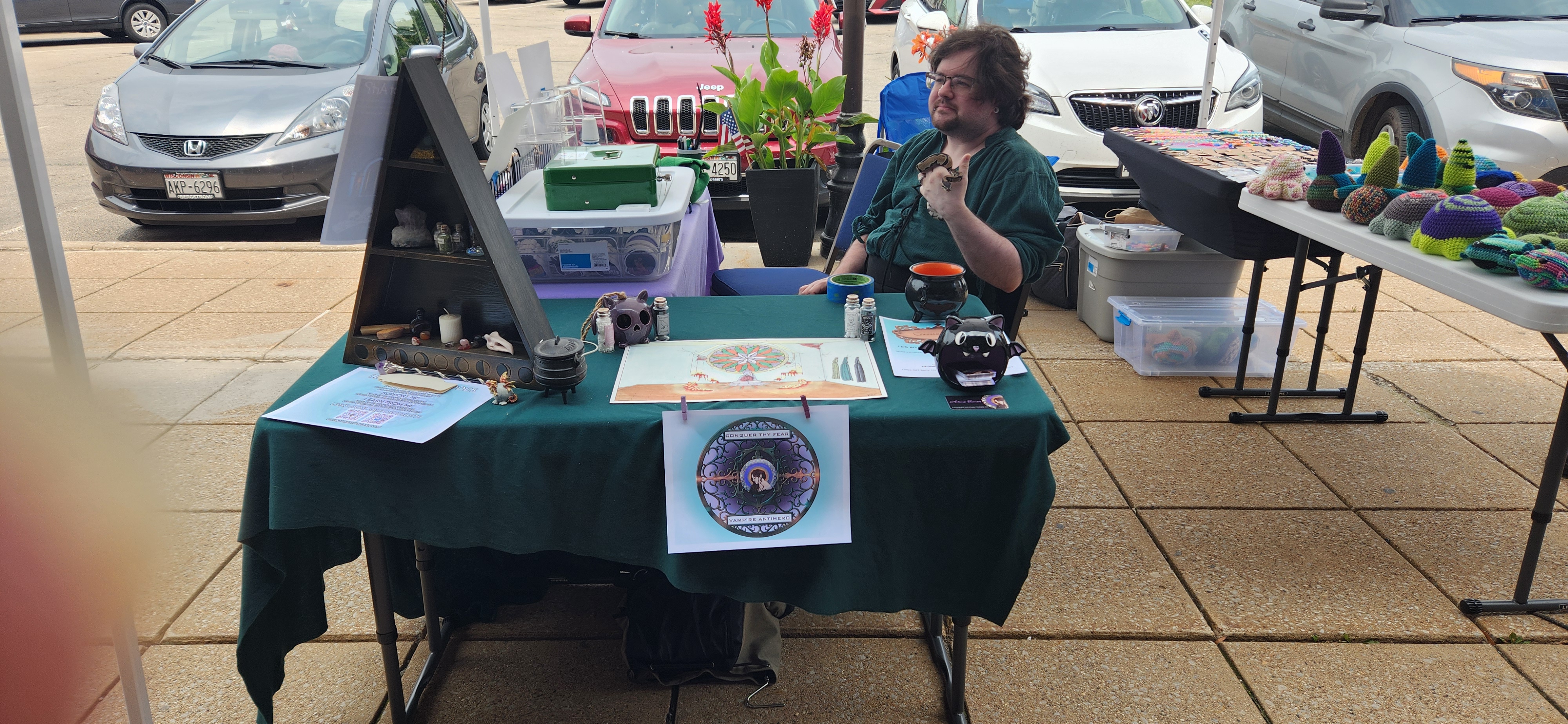
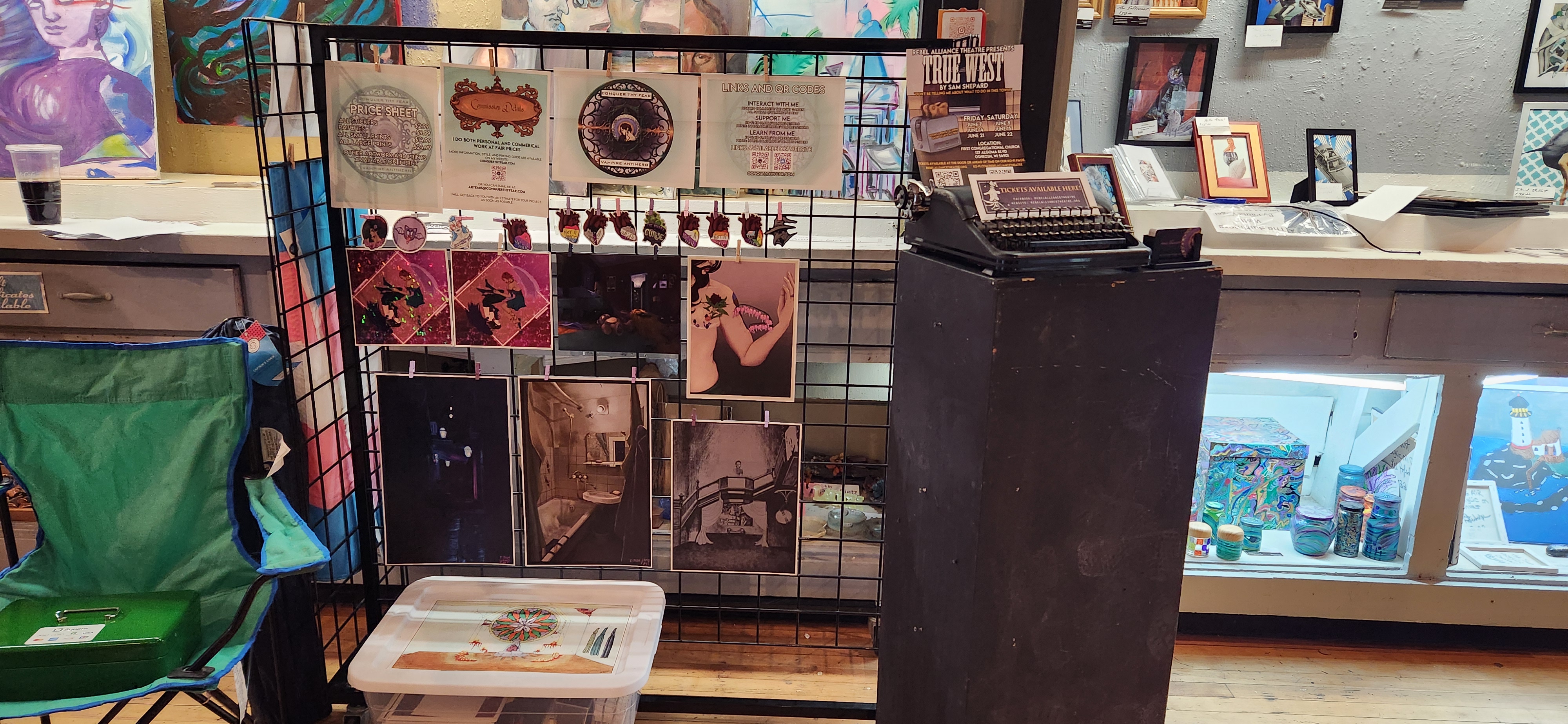
I started tabling at local markets last year, and I won’t pretend to be the most experienced with them. I’ve done six in the last two years. You can tell my tables have evolved in the time that I’ve been doing them, but I’ve kept them pretty simple, and I’ll probably bring this up in more detail later in the pros and cons section. (Side note: I have a friend making me stands and things for the next two markets I’m doing, which will be a much larger level up!)
By the last market I did, I had some upgrades that made my table look nicer, but also, a lot of how I handled my tables was to put them together as cheaply as possible. So now that I’ve shown off a few of my tables, let’s switch gears. When considering whether or not to start something, the best approach is to start with the positives and negatives that are involved with that thing. Start with asking yourself questions about the event, and write down your honest answers to those questions.
Precursor Questions
Some of the questions you should be asking yourself are -- Is this worth my time? What is the effort involved and what are the risks? Are there monetary costs? If yes, will I be able to make those costs back at this event? Are there non-monetary payoffs connected to this event, such as networking or finding leads on clients?
Let’s break these down a little bit. A lot of what is going into these questions is to calculate what types of risk there are involved and whether or not you can have a better experience and/or be more productive elsewhere. With doing anything, especially as a creative business, there are always going to be risks to anything that you do, but going into them with a clear mind and a definite plan will always make the risks feel less overwhelming.
Is this worth my time?
This question is very loaded. For me, what makes an event worth my time is if I get a decent amount of people looking at my table, if I can network or get people interested in using my services, or if I can sell enough to cover costs of the table fee, as well as the cost of whatever I sold. A small bit of the cost that I consider is to compile all of the events I attended throughout the year and see if that covered the cost of my business insurance and left me with any profit. This question may be answered differently for you, so keep this in mind when you’re compiling your list.
What is the effort involved and what are the risks?
This question is really big for me, because my business is not the only thing that I focus on. I’m also involved in running a couple of online Discord communities, (Shameless plug, you can check out Happy Little Accidents, Digital Painting Studio, and my own community The Night Garden by clicking on the titles).
I also write and am very active in a local theatre troupe as well. Time is a very limited resource for me, and I usually ask for help at these events. My husband will help me, and every so often a friend or two will come along as well. People will do this as volunteer, so I usually buy them lunch or something as a thank you for sticking around with me. I’m not so much a morning person, so the earlier that I have to get up, the harder it is for me to get motivated.
How far is it away from me? The travel costs and expenses, plus the effort of packing my car and driving somewhere a given distance away is important to consider, especially if you have helpers coming.
How much am I expected to bring, what is provided, how long will I be at the venue? These are all questions that help me to decide whether or not it’s worth it to do the event.
Are there monetary costs and if yes, can I make my money back?
Usually when it comes to tabling at an event there’s a certain amount of money paid to reserve your seat. Some can be free, whereas others, like conventions, typically have a fairly high price for their tabling costs. You also need to invest a little bit of time and money into designing your table, so that it looks nice and draws people in to look at what you’re selling.
When I look at whether or not I should consider an event, I look at roughly how much inventory I have on hand, what the cost of that stuff was to make it, and whether or not the event that I am vending at is likely to have a high turnout. Other things, like how general or niche the event is, will affect what you bring as merch and whether or not you’ll make good sales. This is harder to gauge, especially if you are new to markets, but it’s definitely something to consider.
The general rule of thumb is that a successful market will make you double your table fee, plus 20%.
Are there non-monetary payoffs to this event like networking or marketing?
Generally, whenever you show your face somewhere, it’s a good opportunity for networking and client leads. This is especially true at more niche events like book-oriented events, TTRPG events, and events where your art fills a niche. You’re more likely to get attention for what you do in events and areas where people will be looking for artists, than you will in events that are geared towards exclusively artists and events that don’t focus on your type of art. This is true of any networking and marketing strategy -- if you cast your net too wide, then you don’t catch many fish, and it makes no sense to throw a net at the other fishermen. What need does your art fill for people? Keeping that in mind will allow you to figure out how to market, or to network with people who may need your expertise.
Okay, I know I’ve thrown a lot at you, but there’s a lot that goes into planning to do an event like this. So, with that in mind, let’s launch into the pros and cons of markets.
Weighing Pros And Cons of Markets
When it comes to looking at the pros and cons of anything, I think it’s important to weigh the pros first. In general, I find it easier to handle looking at the positives first, because negatives are discouraging and can make it so that you lose motivation on your plan. When you think up the positives first, it’s easier to look back at your list of good things and keep your perspective on the negative more realistic, instead of skewing you into a negative mindset.
Again, based on your pre-cursor questions, your pros may be different from mine. Let’s look at my pros list as an example. For me, there’s a few things that I look for. These things will automatically be a pro for me to do an event: It’s in my city, it’s low cost or free to vend, the market has a niche, it has a limited number of hours, and it’s marketed by the venue.
If it’s in my city, it means that there’s low travel costs, and I can ask friends for help manning the table. If the venue is low cost or free to vend, then that means that I have more opportunities to make my money back and cover additional costs, and maybe get a bit of a profit. I mentioned in passing when talking about the precursor questions that displays and stuff for the table are needed to draw people in, and this can be expensive. Keeping costs low and getting a small profit in particular are important because whenever I don’t have a profit, I wind up not getting paid for my work and ultimately cannot sustainably keep the business running.
If the market has a niche, then this is a pro because people are more likely going to be interested in what I’m selling. Think of a niche as a place where you fit in that’s more specific than the general umbrella of art. This might look like doing conventions as a fan art artist, or maybe doing a goth or alternative market if you make dark art. This is something I’ve learned is a pro fo me recently, and most of the markets I’ve vended have been extremely loose. You can think of vending at a general market kind of like shouting into the void. When your market has a niche that fits the art that you are selling, you’re not fighting to get people to see what’s special about your work -- they already see it, because it’s in the realm of things that they enjoy.
If the market has a limited number of hours, then that gives me an idea of how long I’ll be working and how much I’ll have to make above my initial costs to cover my hours of labor. Usually when I have people with me volunteering their time, I’ll try to buy them food, as well, if we’re working through a meal. Usually I try to shoot for events that aren’t longer than four hours, or that have a limited sales window.
If the market is advertised by the venue, then that takes a lot of the legwork away from me. I can mention that I’ll be there, but I’ll also be listed as a vendor on the marketing for that event. This saves me a lot of time and I can basically just post a few reminder posts the day of the event to bring people their direction. People who might not have seen the marketing will come because they’re a fan of my work, and conversely, I’ll have a lot of people check my work out that otherwise would not have known it existed. It’s a win-win situation.
Now, it stands to reason that everything on my pros list holds the opposite as a con, but let’s look at the ways that these pros could be negative for me.
If I only go to events in my city, then I’m severely limiting my own access to people outside of my immediate bubble. This limits networking options, and also always shows relatively the same pool of people the artwork that I vend with at my tables. People won’t need to buy multiples of the same artwork, and they’ll lose interest if I don’t update with anything new. If the market is low-cost or free to vend, then it’s likely low-cost or free to attend. Where there’s nothing wrong with this, people do tend to subconsciously value things they haven’t paid for as much less valuable than things that they have. This means that I’ll have to work harder to get people to pay attention to my work and be willing to pay the price that I set for the cost.
If the market has a niche, or if I only go for markets with a niche audience, this again severely stunts the metric of how many eyes view my work. And, it can be argued that the people viewing in a general market would not be willing to buy anyway, but you never know. You might surprise someone. (This has never personally been the case for me; I’ve had plenty of compliments on my work that don’t convert to sales, but this is just to argue the point.)
If the market is limited in hours, then that understandably sets a limit on when people can come to your vending table. This can make it so that people who would be interested have a harder time coming, or they find out too late to stop by.
If the market is advertised by the venue, then you don’t have the opportunity to add your own unique flair to the marketing, which can lose leads that you’d otherwise be able to get the attention of. That being said, typically venues have way better marketing opportunities than solo artists do, so I think this one is fairly neutral.
There are two sides to every coin, and ultimately, your pros and cons lists will come from what is important to you, as a creative business owner.
My experiences
With that, I’m going to slide a bit more into personal conjecture and talk a little bit about my own experiences with markets. If this isn’t your cup of tea, the chapter times are marked in the video description or on the timeline, feel free to skip this section.
So let me start out by saying that just like how I structure my Youtube channel, I have both digital and traditional artwork that I sell at these markets, but my stock heavily skews digital. I have two original traditional pieces I’ve had a lot of people stop and stare at at the last two markets, but for the most part, people seem most interested in my stickers. The things that I tend to sell the most of are stickers and patches. People stop to look at my prints, but anything larger than 8x10 doesn’t usually sell at markets. People tend to go more for things that they can slip into a pocket, or a bag. I do keep some of my larger prints on hand. I’ve spent time educating people at these events what the difference between traditional and digital art is, and I have had interest in my table.
I live in an area with a ton of events going on at any given moment, and that’s really cool, but this is where I’ve learned that a niche is incredibly important for me. I tend to do best at generalized events around June, mainly because it’s pride month and all of my stickers are pride stickers. It’s really hard to get people’s interest in my dark art outside of October at local events. People stop and compliment my art all the time at generalized events, but it rarely converts to sales.
Out of the six markets I’ve done in the last two years, only two went well for me in the thought of covering my table and initial costs. All six of these events were free for the public to attend; two were free to vend, one was $6 to vend, and the rest were $10 to vend. Two of these events were niche-- I did well at one free niche event and one generalized event that was a $6 fee.I made about $30 in profit for the first one, and about $12 in profit for the second. The last one I went to was one of the worst; it was an art and music event, and I was very close to the stage. I couldn’t hear anything anyone said, people kept crowding my table, a few people outright sat on my table and artwork, and I sold exactly one sticker. It also started to rain three hours in and I left early. I didn’t cover the tabling fee and it was really disappointing. It was super generalized, and people weren’t really there for the art vendors. In hindsight, I probably will not sign up for that event again. I posted a short talking about this on Monday, and there should be a card on the video with a link to that one.
From now on, I think I will only vend at markets that fit into my niche -- dark art, bookish events, and events that focus on fantasy and the supernatural are where my art tends to sell the best. I also have thought about looking into pride events as well, and making some more prints of artwork that are proudly LGBTQIA+ representative, but when I do get inventory for in-person events, I keep the run of things small to keep costs low.
Conclusion/Final Thoughts
Ultimately, what all of this leads up to is that the pros and cons of doing a market very much depend on what your goals are by doing that market, and how much thought you put in before doing the event. I hope that this dive into the things I have considered, helps you as you start to plan your own foray into tabling at art markets.
If you like deep dives like this, then make sure to like the video and subscribe to the blog, the Patreon, the Ko-Fi, or the Youtube channel. I have some tutorials and mentorship updates coming soon. And if you’ve had any experiences with art markets or have any questions for me, leave me a comment below! I’d love to hear from you. Thank you to all of the Ko-Fi and Patreon supporters, I couldn’t keep doing these types of things without you. You guys keep me going, thank you for everything that you do. And, as always, I hope that you are all taking care of yourselves. Drink your water, and do what you can.

Subscribe to our Mailing List

Sub to my Newsletter
and get updates and release news, allowing me to make your world darkly beautiful, one thing at a time.
Copyright 2026. Conquer Thy Fear Studio, LLC. All Rights Reserved.